Thinking about setting up a brokerage or trading business, and Mauritius keeps coming up as the place to do it? You’re not imagining things. Over the last few years, this small island nation has quietly become one of the most talked-about licensing jurisdictions for forex brokers, investment advisors, and dealing firms — and for good reason.
If you’re an entrepreneur in Mauritius looking at offshore options, or simply comparing best offshore jurisdictions for your next venture, this guide walks you through exactly what an investment dealer license in Mauritius involves — the categories, the costs, the paperwork, and the realistic timeline. No jargon, no fluff. Just what you need to know before you talk to a licensing consultant.
What Is an Investment Dealer License in Mauritius?
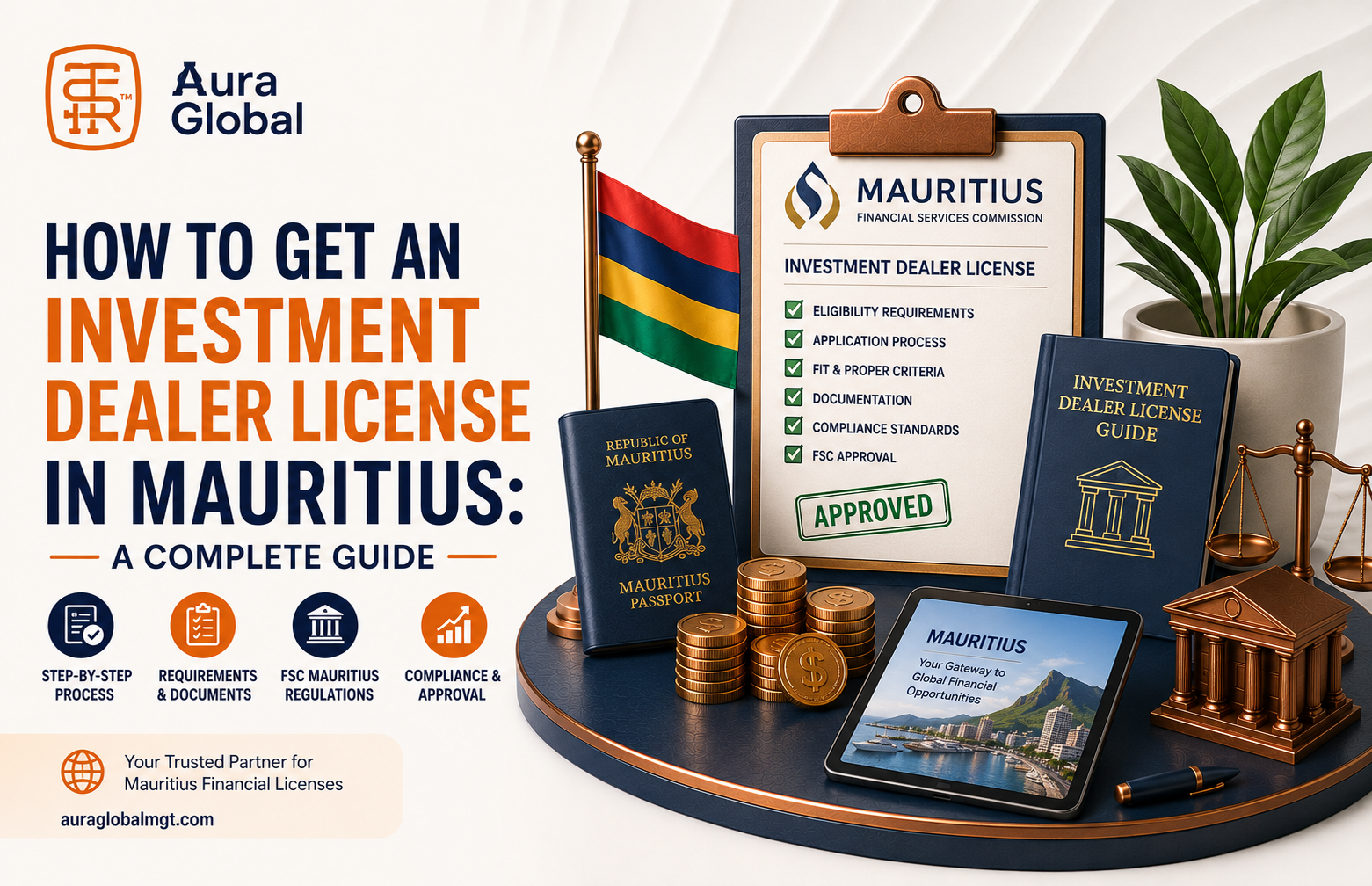
- It’s a license issued by the Financial Services Commission (FSC) Mauritius under the Securities Act 2005
- It allows a company to trade securities, execute client orders, or run a forex broker license in Mauritius-style operation
- There are four license categories, with minimum capital ranging from roughly USD 15,000 to USD 250,000
- Approval typically takes 8 to 12 weeks once a complete application is submitted
- It’s widely considered one of the best Mauritius Forex License options because of low setup costs and a favorable tax regime
What Exactly Is an Investment Dealer License?
An investment dealer license is essentially permission from a country’s financial regulator to legally trade securities, execute client orders, or manage investment portfolios on behalf of others. Think of it as your company’s official “yes, you’re allowed to do this” from the government.
In Mauritius, this permission comes from the FSC — the body responsible for regulating everything outside the banking sector, including securities, insurance, and virtual assets. If you’ve ever wondered why so many forex brokers and trading platforms mention Mauritius in their footer, this license is usually why.
The whole framework runs on two main pieces of legislation: the Securities Act 2005 and the Securities Licensing Rules 2007. Together, these set out who can apply, what capital they need, and how the FSC decides if an applicant is “fit and proper” to operate.
How Does It Actually Work?
Here’s the part most guides skip. You don’t just fill a form and get a license the next day. The FSC reviews your business plan, your team’s background, your compliance setup, and your financial resources before granting approval.
Once approved, your company can operate as a Mauritius Investment Dealer, which means opening a trading platform, onboarding clients, and — depending on your license category — either executing trades, giving advice, or doing both. You’ll also need to stay compliant with Mauritius’s anti-money laundering framework on an ongoing basis, not just at the application stage.
Why Choose Mauritius for an Investment Dealer License?
Aap agar Gulf ya Europe se hain, you’ve probably already looked at Cyprus, Dubai, or maybe Vanuatu. So why does Mauritius keep winning comparisons? A few real reasons:
- Lower capital requirements. Some categories start at under USD 20,000 — far less than what many European jurisdictions demand.
- No capital gains tax and no withholding tax, plus partial tax exemptions for global business companies.
- Strategic time zone. Mauritius sits between Africa, Europe, and Asia, so you can realistically do business with clients across all three regions in the same working day.
- Bilingual, skilled workforce — English and French are both widely spoken, which helps if you’re dealing with African or European clients.
- A hybrid legal system based on English and French law, with the UK Privy Council as the final court of appeal — a level of legal predictability many offshore jurisdictions can’t match.
- Fast, well-organized regulator. The FSC has a reputation for processing applications efficiently compared to more bureaucratic jurisdictions.
Are There Any Risks or Downsides?
To be fair with you — Mauritius isn’t a shortcut, and it’s not the right fit for everyone.
- Ongoing compliance costs. AML/CFT obligations, annual audits, and reporting requirements don’t stop once you’re licensed.
- Physical presence requirements. The FSC expects a genuine operational footprint, not just a mailbox address.
- Not instant. Even in the best case, expect two to three months, and longer if your application is incomplete or your team lacks relevant experience.
- Reputational scrutiny. Because forex and CFD brokers have used offshore licenses to under-regulate in the past, banks and payment providers sometimes apply extra due diligence to Mauritius-licensed entities. A clean, well-documented setup avoids most of these issues.
Investment Dealer License Categories and Capital Requirements
This is the part that actually decides your budget and business model. Mauritius offers four categories:
| License Category | What You Can Do | Minimum Capital (approx.) |
| Full-Service Dealer (with Underwriting) | Execute trades, trade as principal, underwrite securities, give ancillary advice, manage portfolios | USD 220,000–250,000 |
| Full-Service Dealer (excluding Underwriting) | Same as above, minus underwriting activity | USD 22,000–25,000 |
| Investment Dealer (Broker) | Execute client orders, manage portfolios, give trading advice | USD 15,000–17,500 |
| Investment Dealer (Discount Broker) | Execute client orders only, without giving advice | USD 13,800–15,000 |
If your goal is a straightforward forex broker license in Mauritius without underwriting activity, the Broker or Full-Service (excluding underwriting) categories are usually the most practical starting points.
Step-by-Step: How to Get Your Investment Dealer License in Mauritius
- Define your business model first. Are you executing trades, giving advice, managing portfolios, or all three? This decides your license category before anything else.
- Choose your license category based on the activities table above and your available capital.
- Incorporate your Mauritius entity. Most applicants set up a Global Business Company (GBC) as the licensed vehicle.
- Prepare your business plan. This needs to cover your target market, trading platform, use of liquidity providers, and revenue model in real detail — vague plans get rejected or delayed.
- Build your compliance framework. You’ll need AML/CFT policies, a Compliance Officer, and a Money Laundering Reporting Officer (MLRO) appointed.
- Assemble your investment dealer team. The FSC typically expects at least two people with a proven track record in investment dealer services.
- Submit your application to the FSC, along with supporting documents, fit-and-proper declarations, and proof of minimum capital.
- Respond to FSC queries. Expect at least one round of follow-up questions — this is normal, not a red flag.
- Receive your license and set up operations, including your physical office presence in Mauritius, before going live.
Expert Tips Before You Apply
- Don’t underestimate the business plan. A generic template gets flagged fast — the FSC wants specifics on your trading platform, liquidity providers, and target clients.
- Line up your compliance team early. Trying to find a qualified Compliance Officer and MLRO after submission slows everything down.
- Work with a licensing consultant who has recent, direct FSC experience. Processing times of 8–12 weeks are realistic only when your application is complete on the first submission.
- Budget beyond the minimum capital. Office setup, local staff, audit fees, and banking arrangements add real cost on top of the regulatory minimum.
Frequently Asked Questions
1. How much does an investment dealer license in Mauritius cost?
Minimum capital ranges from about USD 13,800 for a Discount Broker license to USD 250,000 for a Full-Service Dealer with underwriting rights. On top of that, budget for incorporation, legal, compliance, and annual operating costs.
2. How long does it take to get licensed?
Most complete applications are processed within 8 to 12 weeks by the FSC. Incomplete submissions or applicants without a strong compliance setup can take considerably longer.
3. Can I get a forex broker license in Mauritius specifically?
Yes — forex brokers typically apply under the Investment Dealer framework, most often the Broker or Full-Service (excluding underwriting) categories, depending on whether they give trading advice.
4. Do I need a physical office in Mauritius?
Yes. The FSC expects genuine physical presence and local substance, not just a registered address, as part of the licensing conditions.
5. Is Mauritius a good alternative to Offshore Company Formation in Europe or the Gulf?
For many small and mid-sized dealing firms, yes. Mauritius offers materially lower capital requirements and a favorable tax regime compared to several European licensing jurisdictions, while still maintaining a FATF-compliant regulatory framework.
6. What’s the difference between an Investment Advisor License and an Investment Dealer License in Mauritius?
An Investment Dealer license covers trade execution and dealing activities, while an Investment Advisor License is generally structured around giving investment advice without executing trades directly. Your intended activities determine which one fits.
Final Thoughts
Getting an investment dealer license in Mauritius isn’t complicated once you understand the categories and what the FSC actually wants to see. The bigger factor is preparation — a clear business plan, a qualified compliance team, and realistic capital planning make the difference between an 8-week approval and a drawn-out back-and-forth.
If you’re weighing Mauritius against other Forex Licensing Jurisdictions, it’s worth getting a category-by-category comparison done for your specific business model before you commit capital.
Ready to explore your options? Get in touch with Auraglobalmgt for a free consultation on which Mauritius Investment Dealer License category fits your business.