Thinking about launching a forex brokerage from Mauritius? Aap sahi jagah pe hain. Before you register a single document, you need one number: the real cost.
Not the number a sales page shows you. The number you’ll actually pay once capital, fees, office, and compliance are all added up.
This guide breaks down the forex broker license cost in Mauritius, step by step, so you can budget like a professional — not guess like a beginner.
Quick Answer: Mauritius Forex Broker License Cost at a Glance
- Application fee: roughly $550–$750 (paid to the FSC)
- Annual license fee: roughly $2,500–$3,000 per year
- Minimum capital: varies by license class — from around $18,000–$33,000 for a broker-dealer, up to roughly $180,000 for a full-service Investment Dealer license
- Total realistic first-year budget: typically €30,000–€70,000+, once incorporation, local office, directors, and compliance drafting are included
- Processing time: usually 3–7 months, depending on the license category and how complete your application is
Keep these ranges in mind — they set the tone for everything below.
What Is a Forex Broker License?
A forex broker license is a formal authorization from a financial regulator that allows a company to legally deal in, or arrange dealing in, foreign exchange and CFD instruments on behalf of clients.
In Mauritius, this authorization is issued by the Financial Services Commission (FSC) and is formally known as an Investment Dealer license, granted under a Global Business License structure. There’s no separate “forex license” category — forex brokerage sits inside this wider investment dealer framework.
Why Brokers Choose Mauritius Among Forex Licensing Jurisdictions
If you compare forex licensing jurisdictions side by side, Mauritius consistently lands in the “sweet spot.” Here’s why:
- Lower cost than Tier-1 regulators. CySEC (Cyprus) or the FCA (UK) can cost EUR/GBP 200,000–1,000,000+ all-in, with 6–18 month timelines. Mauritius is a fraction of that.
- Real banking access. Unlike ultra-cheap offshore options such as St Vincent or Anjouan, Mauritius brokers can actually open working bank accounts and connect to serious payment processors.
- Tax efficiency. The headline corporate tax rate is 15%, but licensed Global Business Companies typically enjoy an effective rate closer to 3% through a partial exemption on foreign income.
- Credibility. The FSC is a member of IOSCO, giving your license international recognition — even though it doesn’t offer EU passporting.
- Strategic location. Sitting between Africa and Asia, with a manageable time-zone overlap with Europe, Mauritius works well for brokers targeting multiple regions at once.
This is why “Mauritius forex broker license” and “investment dealer license in Mauritius” are two of the most searched terms among founders comparing offshore jurisdictions this year.
How the Mauritius Forex License Works
There isn’t just one Mauritius forex license — there are a few categories, and your choice directly changes your cost.
1. Broker-Dealer License
Designed for companies acting as intermediaries — executing trades without taking market positions themselves. This is the lighter, more affordable entry point.
2. Investment Dealer (Full-Service) License
This is the broader option, covering forex trading, CFDs, securities dealing, and in some cases underwriting or portfolio management. It requires significantly higher paid-up capital, held permanently in a Mauritian bank account.
Most forex-focused startups begin with the broker-dealer route and expand later once they have real trading volume.
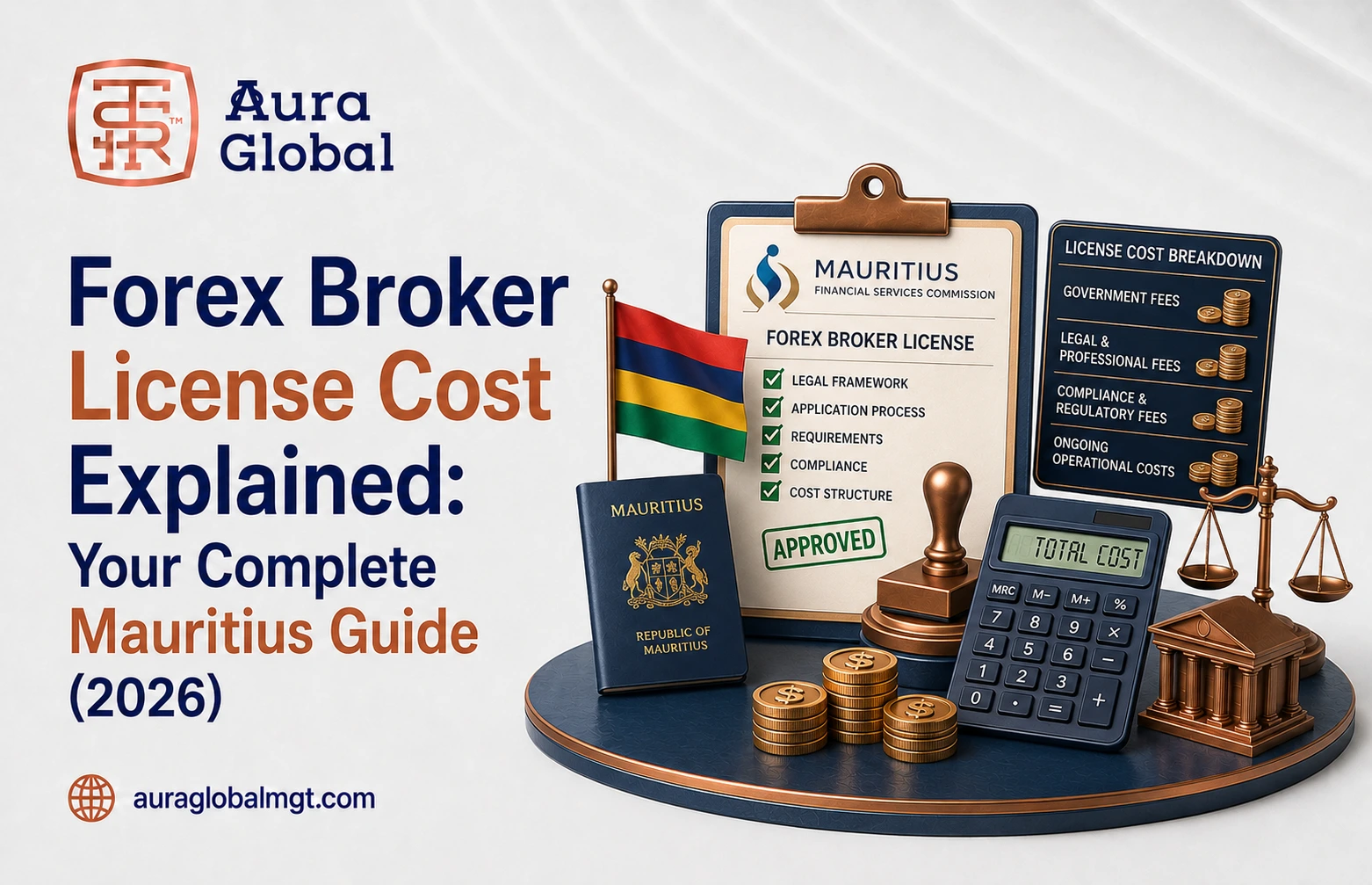
Forex Broker License Cost in Mauritius: The Full Breakdown
Yahan pe hum real numbers dekhte hain — not marketing estimates.
| Cost Component | Broker-Dealer License | Full-Service Investment Dealer |
| Minimum capital | ~$18,000–$33,000 | ~$180,000 (approx. MUR 9 million) |
| FSC application fee | ~$550–$750 | ~$750+ |
| Annual license fee | ~$2,500–$3,000 | ~$3,000+ |
| Processing time | 3–4 months | 4–7 months |
Beyond the regulator’s fees, budget separately for:
- Company incorporation and secretarial support — setting up your Global Business Company correctly from day one
- Local substance requirements — a physical office, at least two resident directors, and local staff, since Mauritius now enforces meaningful on-island presence
- Legal and compliance drafting — your business plan, AML/CFT manuals, risk policies, and governance documents
- Banking and payment onboarding — often underestimated, but high-risk merchant acceptance and reserve requirements can affect both your budget and your launch date
- Technology setup — trading platform or white-label licensing, KYC tools, sanctions screening, and liquidity provider connections
Put together, most founders should plan for a realistic first-year budget of €30,000 to €70,000 or more, not just the headline application fee you’ll see advertised.
Benefits of Getting Licensed in Mauritius
- Lower entry barrier than Europe, without sacrificing real regulatory credibility
- Access to double taxation treaties with over 45 countries
- No capital gains tax, and no withholding tax on dividends or interest
- Faster approval compared to Tier-1 jurisdictions like Cyprus or the UK
- Established FSC directory — you’ll be listed alongside recognized brokers, which helps with client trust and payment processor onboarding
Risks and Challenges to Plan For
No jurisdiction is risk-free, and Mauritius is no exception.
- Substance requirements add ongoing cost. A local office, resident directors, and local employment contracts aren’t optional extras — they’re compliance essentials.
- Regulatory tightening. Following Mauritius’s efforts to exit the FATF grey list, the FSC has increased scrutiny, meaning more documentation and, occasionally, evolving fee structures.
- Capital must stay liquid. Your minimum capital isn’t a one-time payment — it must be maintained in a Mauritian bank account at all times.
- Not a shortcut to EU clients. Mauritius licensing does not grant EU passporting, so if your target market is strictly the EU or UK, you’ll eventually need CySEC or FCA authorization too.
Step-by-Step Guide to Applying for a Mauritius Forex License
- Initial structuring and due diligence — KYC checks on shareholders and directors, plus an FSC name check for your company.
- Choose your license category — broker-dealer vs. full-service Investment Dealer, based on your business model and budget.
- Incorporate your Global Business Company — typically takes 3–4 weeks with a licensed management company.
- Prepare your application package — business plan, AML/CFT policies, financial projections, and director/shareholder documentation.
- Submit to the FSC — scanned documents first, followed by originals; incomplete applications get returned, so accuracy matters.
- Respond to FSC queries — most delays happen here, not at the initial submission.
- Fund your capital account — deposit your minimum capital into a Mauritian bank once approval is close.
- Go live — once licensed, register your compliance officer and MLRO, and begin operations under your FSC reporting obligations.
Expert Tips to Control Your Costs
- Don’t choose your license category based on price alone. Under-licensing now often means a costly upgrade later.
- Budget for substance from day one. Office and local staff costs are recurring, not one-off — treat them as part of your annual operating cost, not your setup cost.
- Work with a local management company. A Mauritius license legally requires one, and the right partner can prevent expensive rejection cycles.
- Separate regulatory cost from operational cost. The FSC fee is the smallest line in your budget — technology, banking, and compliance drafting usually cost more combined.
- Verify current fee schedules directly with the FSC before finalizing your budget, since public figures across the web vary by license class and update over time.
FAQs
1. What is the minimum capital required for a forex broker license in Mauritius?
Minimum capital depends on your license category. A broker-dealer license typically requires around $18,000–$33,000, while a full-service Investment Dealer license requires significantly more — roughly $180,000. This capital must stay deposited in a Mauritian bank account at all times, not just at application.
2. How long does it take to get a Mauritius forex license?
Most broker-dealer applications take 3–4 months, while full-service Investment Dealer licenses can take 4–7 months. Timelines depend heavily on how complete and accurate your initial application is — incomplete submissions get returned by the FSC, adding weeks of delay.
3. Is Mauritius cheaper than getting a Cy SEC or FCA license?
Yes, significantly. A CySEC or FCA license can cost EUR/GBP 200,000–1,000,000+ all-in with 6–18 month timelines. Mauritius offers real banking access and international credibility for a fraction of that cost, though it doesn’t grant EU passporting.
4. Do I need a physical office in Mauritius to get licensed?
Yes. The FSC requires meaningful local substance, including a physical office, at least two resident directors, and local employment contracts. This is a mandatory ongoing cost, not a one-time setup expense, and it’s often underestimated in early budgets.
5. What’s included in the total cost of a Mauritius forex license?
Beyond the FSC application and annual fees, budget for incorporation, local office and staff, legal and compliance drafting (AML/CFT manuals, business plan), banking and payment onboarding, and trading technology. Realistic first-year totals typically range from €30,000 to €70,000+.
6. Can I upgrade from a broker-dealer to a full-service license later?
Yes, this is a common path. Many brokers start with the lower-capital broker-dealer license to launch faster and build trading volume, then upgrade to a full-service Investment Dealer license once the business justifies the higher capital commitment.
Conclusion: Is Mauritius Worth the Cost?
For most mid-sized brokers, yes. The forex broker license cost in Mauritius sits comfortably between cheap-but-weak offshore registrations and expensive Tier-1 regulation — giving you real banking access, tax efficiency, and international credibility without a seven-figure setup bill.
If you’re ready to move forward, the smartest next step isn’t filing paperwork — it’s getting your license category and budget confirmed by a licensing specialist who knows the current FSC requirements.
Ready to explore your Mauritius forex license options? Talk to the Auraglobalmgt team today and get a clear, accurate cost breakdown for your specific business model.