
The Critical Decision for Forex Entrepreneurs
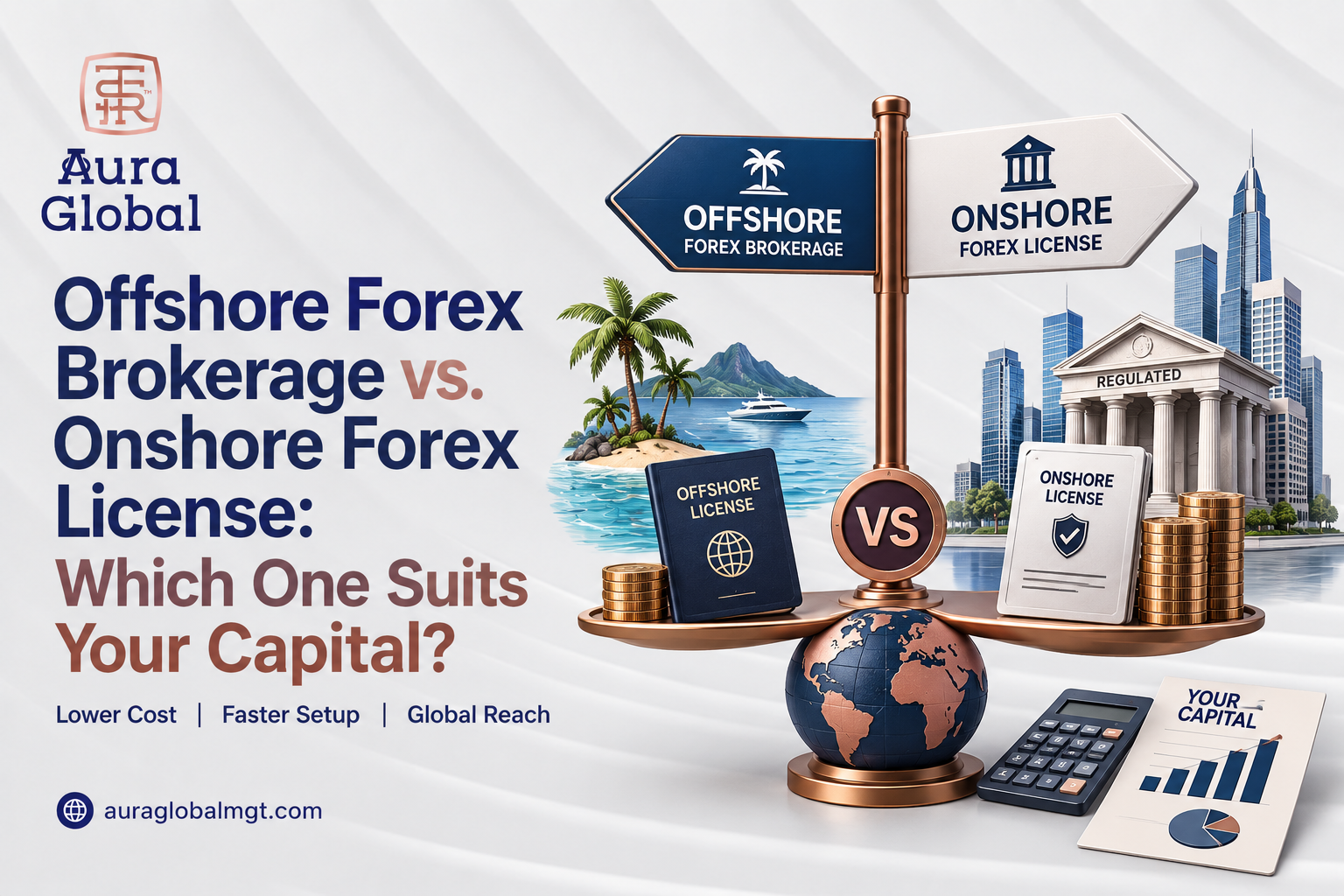
If you’re thinking about launching a forex brokerage, you’re probably sitting on a major crossroads. Should you go with an offshore forex license that promises speed and flexibility, or pursue an onshore forex license that offers legitimacy and stability?
The truth is, there’s no one-size-fits-all answer. Your choice depends on your capital, risk appetite, compliance readiness, and long-term vision. This guide breaks down both paths so you can make an informed decision without the jargon.
By the end of this article, you’ll understand the mechanics of both options, their costs, regulatory requirements, and which path aligns with your business goals.
What Are Offshore and Onshore Forex Licenses?
Offshore Forex Brokerage: Definition & Basics
An offshore forex brokerage is registered and regulated in countries outside major financial centers. Think of jurisdictions like the Seychelles, Mauritius, Cyprus, or Vanuatu. These regulatory bodies are more flexible and typically cheaper to navigate than Western regulators.
Key characteristics:
- Regulated by less stringent financial authorities
- Lower setup costs (typically $50,000–$250,000)
- Faster licensing timelines (3–6 months)
- More flexible trading conditions and leverage rules
- Easier to target international clients
Offshore doesn’t mean unregulated—it means regulated by jurisdictions outside traditional financial hubs. Mauritius, for example, has a solid regulatory framework through the Financial Services Commission (FSC), making it a trusted offshore hub in Africa and Asia.
Onshore Forex License: Definition & Basics
An onshore forex license means your brokerage operates within a major financial jurisdiction—the US (CFTC/NFA), UK (FCA), Australia (ASIC), or EU (MiFID II). You’re regulated by the strictest, most respected authorities globally.
Key characteristics:
- Regulated by tier-1 financial regulators
- Higher setup costs ($500,000–$2M+)
- Longer approval timelines (12–24 months)
- Strict capital requirements and ongoing compliance
- Fewer trading leverage restrictions but more operational oversight
- Access to tier-1 banking and liquidity providers
Onshore licenses are the gold standard for trust and credibility but require serious capital and compliance infrastructure.
How Offshore and Onshore Forex Brokerages Work
The Offshore Workflow
- Choose your jurisdiction – Mauritius, Cyprus, or Seychelles are popular
- Prepare documentation – Business plan, background checks, bank references
- Submit to the regulatory body – Typically 30–60 days for review
- Receive license – Usually within 3–6 months
- Set up operations – Hire compliance officer, establish banking relationships
- Launch platform – Integrate with MT4/MT5, open liquidity providers, go live
Offshore setup is straightforward because regulators prioritize efficiency. You’re not jumping through 50 hoops; they expect you to grow fast.
The Onshore Workflow
- Select your tier-1 regulator – CFTC (USA), FCA (UK), ASIC (Australia)
- Build compliance infrastructure – Hire compliance experts, set up risk management systems
- Prepare exhaustive documentation – 200+ pages of policies, procedures, financials
- Submit application – Often involves callbacks, additional requests
- Pass audits – Banking audits, compliance audits, capital verification
- Receive license – 12–24 months later
- Maintain ongoing compliance – Monthly reporting, annual audits, staff training
Onshore licensing is a marathon. These regulators want to know every detail about your operations, your officers, your clients, and your risk management. It’s thorough because your license protects retail traders.
Offshore Forex License vs. Onshore: Key Differences at a Glance
| Aspect | Offshore Forex License | Onshore Forex License |
|---|---|---|
| Setup Cost | $50K–$250K | $500K–$2M+ |
| Timeline | 3–6 months | 12–24 months |
| Leverage Rules | Flexible (100:1+) | Restricted (50:1 for retail) |
| Client Base | International | Primarily domestic |
| Regulatory Scrutiny | Moderate | Very high |
| Banking Access | Tier-2 providers | Tier-1 providers |
| Compliance Burden | Light-to-moderate | Heavy |
| Expansion Ease | High | Complex (new jurisdictions = new licenses) |
| Perceived Credibility | Growing (varies by jurisdiction) | Highest |
Benefits of Offshore Forex Brokerage
1. Lower Capital Requirements
Starting an offshore forex brokerage doesn’t drain your savings. You’re looking at $100K–$150K for licensing, compliance, and initial operations. Onshore? You need 10 times that.
2. Faster Time-to-Market
You could have a live, regulated brokerage in 4–5 months. That speed advantage matters when you’re targeting fast-growing markets like Southeast Asia or Latin America.
3. Flexible Trading Conditions
Offshore regulators don’t restrict leverage to 50:1. You can offer 100:1, 200:1, or even higher—whatever your risk model supports. This appeals to professional and institutional traders.
4. Global Client Base
Offshore licenses let you serve clients worldwide (with some exceptions like the US). You’re not limited to one country’s retail traders.
5. Easier Scalability
Want to add a prop trading desk? Launch a crypto arm? Offshore frameworks are flexible enough to accommodate these without reapplying for licenses.
6. Attractive Jurisdictions
Mauritius, Cyprus, and Seychelles have solid reputations. Mauritius especially benefits from its proximity to African and Asian markets, plus a strong regulatory framework that rivals developed nations.
Benefits of Onshore Forex License
1. Maximum Credibility
Clients see an FCA or CFTC license and instantly trust you. That badge of honor opens doors to institutional capital, partnerships, and premium clients.
2. Access to Tier-1 Banking
Major banks work with onshore brokers. Your operations run smoothly with no fund delays or banking complications.
3. Regulatory Protection
You’re operating under the strictest standards. That protection applies to your clients too—they know their funds are segregated and protected.
4. Institutional Business
Hedge funds, asset managers, and institutional traders prefer onshore brokers. If that’s your market, onshore is non-negotiable.
5. Expansion Legitimacy
Expanding into new markets is easier when you already have a tier-1 license. Regulators in tier-2 jurisdictions respect FCA or ASIC approval.
6. Higher Valuations
Onshore brokers command premium valuations in M&A scenarios. When you sell, the buyer pays more for that regulatory pedigree.
Risks & Challenges: What You Need to Know
Offshore Forex Brokerage Risks
1. Regulatory Scrutiny Increase Regulators like ESMA (Europe) and CFTC (USA) are tightening rules around offshore brokers. Mauritius and Cyprus are still solid, but smaller jurisdictions face pressure.
2. Banking Challenges Tier-1 banks are wary of forex brokers. Even offshore brokers face difficulty opening accounts. You’ll likely use tier-2 or specialized banking partners, which carry higher costs.
3. Client Perception Some retail traders still associate “offshore” with risk. You’ll need strong marketing to overcome that bias—especially competing against FCA-regulated brokers.
4. Regulatory Complexity by Country You can’t just take your Mauritius license to the EU. Each country has rules. UK clients are off-limits under ESMA restrictions. You need to geo-block and adapt.
5. Compliance Drift Risk Lighter oversight means you own compliance fully. One misstep, and your regulator pulls your license. You need strong internal controls.
Onshore Forex License Risks
1. Massive Capital Commitment You’re locking in $500K–$2M before you serve a single client. That’s a huge financial burden if your business model fails.
2. Regulatory Burden Compliance isn’t one-and-done. You’re reporting monthly, undergoing audits, training staff, and updating policies constantly. Your compliance team is expensive and essential.
3. Speed-to-Market Lost By the time you’re licensed, competitors have captured market share. In fintech, that delay hurts.
4. Limited Flexibility You can’t just pivot to prop trading or add leveraged products. Each change requires regulatory approval. That slows innovation.
5. Expansion Complexity Want to serve Australia? You need an ASIC license. EU clients? MiFID II compliance. Each jurisdiction = separate licenses, separate capital, separate infrastructure.
Step-by-Step: How to Launch Your Forex Brokerage
For Offshore Forex Brokerage Setup
Step 1: Choose Your Jurisdiction
- Mauritius: Strong FSC framework, regional credibility
- Cyprus: European base, CySEC regulation
- Seychelles: Lower costs, niche appeal
Step 2: Prepare Your Business Plan
- Revenue model (spreads, commissions, managed accounts)
- Target market (retail, institutional, prop traders)
- Technology stack (MT4, MT5, or proprietary)
- Compliance framework
Step 3: Secure Initial Capital
- Minimum $100K–$150K for all costs
- $30K–$50K for licensing and regulatory fees
- $50K–$70K for tech, compliance hiring, marketing
Step 4: Hire a Compliance Officer
- Must understand your jurisdiction’s rules
- Cost: $2K–$5K/month
Step 5: Open a Corporate Bank Account
- Provide business registration, compliance documents
- Many banks take 4–8 weeks
Step 6: Integrate Liquidity
- Partner with liquidity providers (e.g., White Label solutions)
- Cost: $10K–$30K setup + monthly fees
Step 7: Apply for License
- Submit to regulator with all documentation
- Expect 30–60 day review
- Back-and-forth with regulators is normal
Step 8: Go Live
- Launch with phased rollout
- Start with regulated markets or testing
- Gradually expand client base
Timeline: 4–6 months
For Onshore Forex License Setup
Step 1: Choose Your Regulator
- CFTC (US): Strictest, largest market
- FCA (UK): European base, respected globally
- ASIC (Australia): Growing market, solid reputation
Step 2: Build Your Compliance Infrastructure
- Hire compliance officer ($80K+/year)
- Hire legal counsel ($200K+/year)
- Build risk management systems
Step 3: Prepare Comprehensive Documentation
- Anti-money laundering (AML) policies
- Know Your Customer (KYC) procedures
- Risk management frameworks
- Cybersecurity policies
- Business continuity plans
- Conflict of interest policies
- 200+ pages of operational procedures
Step 4: Secure Minimum Capital
- CFTC: $20M minimum net capital
- FCA: £730K+ minimum capital
- ASIC: AUD $500K minimum capital
Step 5: Apply to Regulator
- Submit comprehensive application
- Expect callbacks and requests for clarification
- Prepare for on-site inspections
Step 6: Pass Audits & Verification
- Banking audits (fund segregation)
- Compliance audits
- IT security audits
Step 7: Receive License
- Approval takes 12–24 months
- Conditions and ongoing requirements attached
Step 8: Ongoing Compliance
- Monthly reporting to regulator
- Annual audits
- Staff training and certification
- Policy updates as regulations evolve
Timeline: 12–24 months (or longer)
Expert Tips for Success
For Offshore Brokerage Owners
1. Invest in Compliance Early Don’t skimp on compliance officers and AML/KYC systems. Regulators in Mauritius and Cyprus are cracking down on bad actors. You want to be squeaky clean.
2. Build Banking Relationships Banks are the gatekeeper. Establish relationships early, provide transparency, and maintain tight controls. A good banking partner makes everything easier.
3. Focus on Your Niche You can’t compete with FCA brokers on trust alone. Own a specific market—emerging market traders, prop trading, copy trading—and dominate it.
4. Invest in Technology & UX Your platform is your brand. A clunky interface loses clients to competitors. Invest in modern tech, fast servers, and smooth trading experiences.
5. Be Transparent About Regulation Clearly explain your regulatory status to clients. “Regulated by the Mauritius FSC” is perfectly legitimate. Own it, don’t hide it.
For Onshore Brokerage Owners
1. Hire Compliance Experts Early Your compliance officer and legal team are not overhead—they’re revenue protection. They prevent catastrophic regulatory failures.
2. Automate Reporting With monthly regulatory reporting, use software to automate data collection. Manual reporting is error-prone and expensive.
3. Anticipate Regulatory Changes Read CFTC notices, FCA updates, and industry advisories constantly. Regulators signal changes before they happen. Adapt proactively.
4. Build Institutional Relationships If you have an onshore license, leverage it. Target asset managers, hedge funds, and institutional traders who demand tier-1 regulation.
5. Plan for Expansion Onshore licenses are jurisdiction-specific. If you want global reach, plan multiple licenses or partnerships early.
Offshore Forex Brokerage vs. Onshore: Which Should You Choose?
Choose Offshore Forex License If:
- You have $100K–$200K capital
- You want to launch in 4–6 months
- Your target clients are international (non-US, non-UK retail)
- You want flexibility in trading conditions
- You’re building a specific niche (prop trading, emerging markets)
- Mauritius or Cyprus jurisdiction appeals to you
Choose Onshore Forex License If:
- You have $500K–$2M+ capital
- You’re targeting institutional or high-net-worth clients
- Regulatory credibility is your primary differentiator
- You plan to expand into multiple tier-1 jurisdictions
- You want access to the largest, most stable client bases
- Your timeline is 12–24 months or longer
Mauritius as an Offshore Forex Hub: Why It Matters
If you’re considering offshore, Mauritius deserves serious attention. Here’s why:
Regulatory Excellence: The Mauritius Financial Services Commission (FSC) rivals developed-nation standards. It’s transparent, efficient, and internationally respected.
Strategic Location: Mauritius sits between Africa, Asia, and the Indian Ocean. It’s ideal for targeting emerging markets in Africa, India, and Southeast Asia.
Cost Advantage: Licensing and compliance costs are 30–40% lower than Cyprus or Malta, with comparable quality.
Stable Democracy: Mauritius ranks as the most stable country in Africa. That stability attracts serious capital and partners.
English-Speaking Workforce: Finding talented compliance officers, developers, and customer service staff is easy—they speak English fluently.
Growing Forex Hub: Firms like Aura Global Management (auraglobalmgt) are building world-class brokerages from Mauritius. It’s becoming the African gateway for global forex trading.
If you’re exploring offshore without a specific jurisdiction in mind, Mauritius checks every box.
FAQ: Common Questions About Forex Licenses
Q1: How much does an offshore forex license cost?
Answer: An offshore forex license typically costs $50,000–$250,000 total. This includes regulatory fees ($20K–$50K), licensing applications ($10K–$20K), compliance officer salary (first 6 months: $15K–$30K), technology setup ($20K–$50K), and banking/liquidity setup ($10K–$30K). Mauritius-based licenses tend toward the lower end of this range due to competitive fees. Exact costs depend on your jurisdiction, business model, and technology choices. Always budget an extra 20–30% for unexpected expenses.
Q2: Can I operate an offshore forex brokerage from my home country?
Answer: Technically yes, but it’s complicated. If you’re licensed in Mauritius, you can operate from Mauritius or a satellite office elsewhere—but some countries restrict this. For example, the UK’s FCA prohibits UK residents from promoting offshore brokers without proper passporting. Always check local laws in your home country before launching. Many offshore operators maintain a registered office in their jurisdiction and a working office elsewhere. Consult a local lawyer first.
Q3: What’s the difference between offshore and unregulated?
Answer: Offshore means regulated by a non-tier-1 authority like Mauritius FSC or Cyprus CySEC. Unregulated means no regulatory oversight at all. These are completely different. Offshore brokers operate under strict rules, report to regulators, and maintain compliance standards. Unregulated brokers have zero oversight and pose serious client risk. Never launch unregulated—it’s illegal in most countries and will destroy your reputation. Always choose offshore (regulated) over unregulated.
Q4: How long does it take to get an onshore forex license?
Answer: Expect 12–24 months, sometimes longer. CFTC licenses (US) typically take 18–24 months. FCA licenses (UK) average 12–18 months. ASIC licenses (Australia) take 6–12 months. Timelines vary based on application completeness, regulatory workload, and whether you need back-and-forth clarification. Complex business models take longer. Some applicants wait 2+ years. Plan accordingly and don’t underestimate the timeline when budgeting.
Q5: Can I start offshore and transition to onshore later?
Answer: Yes, many brokers do this. You launch offshore to validate your business model, build capital, and establish operations. After 1–2 years of clean compliance, you apply for onshore licenses. The transition is easier because you already have compliance infrastructure, regulatory experience, and audited financials. Some clients and partners will even accelerate this transition by requesting onshore status. It’s a viable growth path.
Q6: What’s the minimum capital requirement for offshore vs. onshore licenses?
Answer: Offshore licenses have no strict minimum capital—it depends on your regulator’s requirements. Mauritius FSC typically requires $100K–$500K in liquid capital based on your client base and leverage offerings. Onshore licenses have hard minimums: CFTC requires $20M net capital (staggering), FCA requires £730K+, ASIC requires AUD $500K+. Onshore minimums are non-negotiable and enforced strictly. Capital adequacy is ongoing—you must maintain minimums always.
The Bottom Line: Your Capital, Your Choice
Choosing between an offshore forex license and an onshore forex license isn’t about which is “better”—it’s about which fits your capital, timeline, and vision.
Offshore is for entrepreneurs who want speed, flexibility, and lower upfront costs. Mauritius, Cyprus, and Seychelles offer legitimate, regulated environments where you can build a credible brokerage in 4–6 months.
Onshore is for serious institutions with significant capital and a 2-year timeline. It’s the path to tier-1 credibility, institutional clients, and premium valuations—but only if you can afford it.
Many successful brokers start offshore, build operations, then transition onshore. There’s no shame in that journey. It’s smart strategy.
Ready to launch your forex brokerage? Start by clarifying your capital, timeline, and target market. Those three factors will guide your entire decision. Then, connect with experienced licensing consultants who know your chosen jurisdiction inside and out.