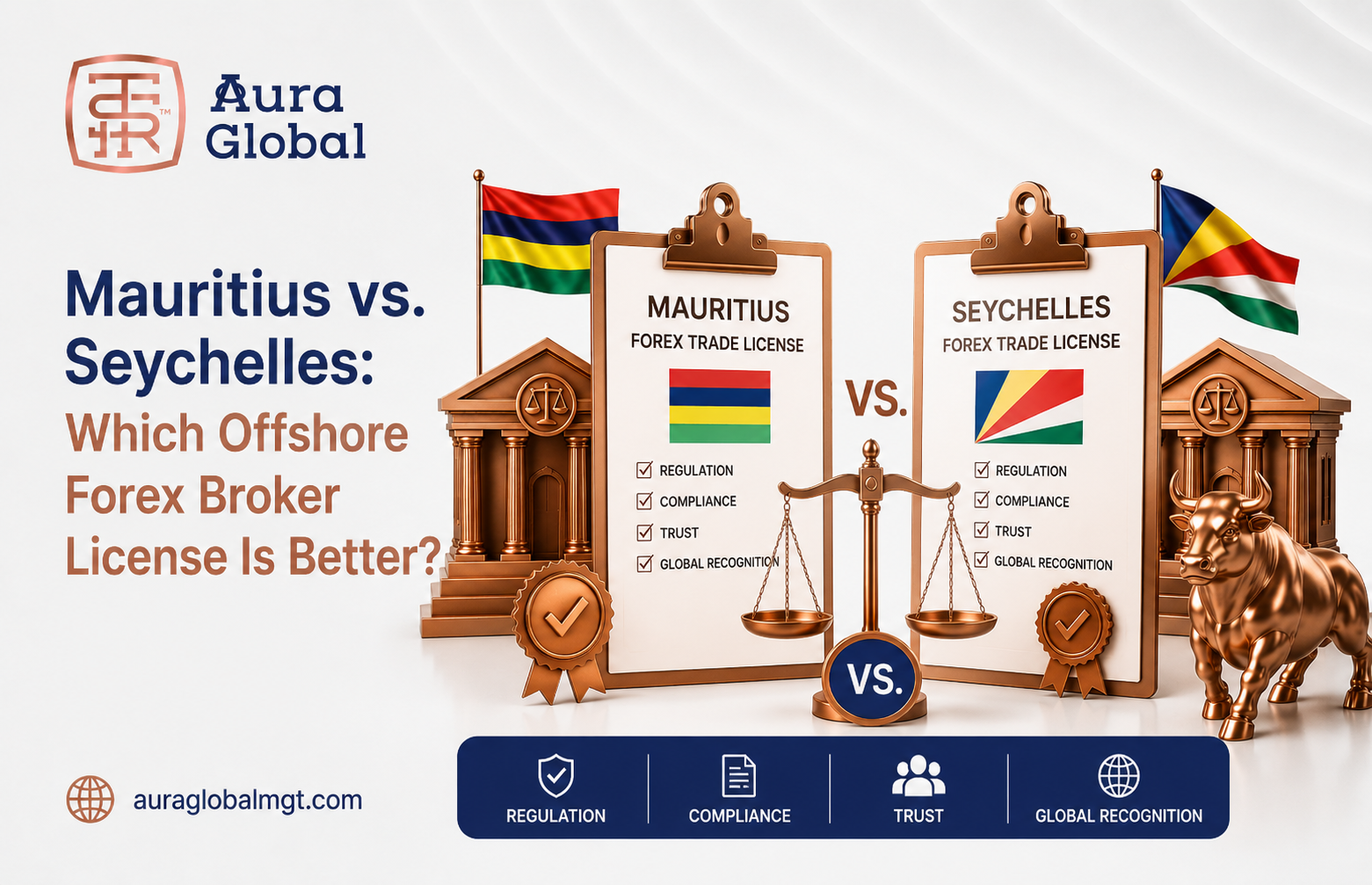
Choosing where to license your forex brokerage is the single most consequential decision you will make before a single trade crosses your platform. Two names surface in nearly every serious conversation about offshore forex licensing: Mauritius and Seychelles. Both offer legitimate pathways to market, both have carved out reputations as broker-friendly jurisdictions, and both attract founders from London to Dubai. Yet the differences between them — in cost, credibility, compliance burden, and banking access — are stark enough to shape the entire trajectory of your business.
If you are reading this, you are probably weighing those differences right now. Perhaps you have mapped out a business plan for a CFDs brokerage targeting retail traders across Asia or Africa. Perhaps you are an established broker looking for a secondary licence in a cost-effective jurisdiction. Or perhaps you are starting from scratch and simply want to know which door opens more easily. Wherever you sit, this guide will walk you through what actually matters — not marketing fluff, but the operational, financial, and reputational realities that determine whether Mauritius or Seychelles fits your brokerage.
Defining Offshore Forex Broker Licensing
Before we compare jurisdictions, let us settle what an offshore forex broker licence actually is — because the term gets thrown around loosely, and the misconceptions are expensive.
An offshore forex broker licence is a regulatory authorisation issued by a jurisdiction outside the broker’s primary country of operation. It permits the holder to offer foreign exchange and, in most cases, contracts-for-difference (CFD) trading services to clients internationally. The “offshore” label does not mean unregulated, nor does it imply anything underhand. Jurisdictions like Mauritius and Seychelles operate under financial services commissions that enforce real compliance obligations — capital adequacy requirements, anti-money laundering frameworks, periodic reporting, and customer protection rules.
What distinguishes an offshore licence from an onshore one — say, from the UK’s Financial Conduct Authority (FCA) or Cyprus’s CySEC — is primarily cost, speed, and the breadth of passporting rights. An FCA licence might open every door in Europe but will cost you well into six figures and take the better part of a year. A Mauritius FSC licence or a Seychelles FSA licence, by contrast, can be operational in two to three months at a fraction of the cost, while still giving you a credible regulatory badge that banks, liquidity providers, and traders recognise.
The trade-off, as you will see, lies in the details.
The Mauritius Forex Broker Licence: A Deep Dive
Mauritius has spent the last two decades building one of Africa’s most respected financial services ecosystems. The Financial Services Commission (FSC) of Mauritius regulates the non-banking financial sector, and it does so under standards aligned with the OECD, the Financial Action Task Force (FATF), and the International Organisation of Securities Commissions (IOSCO). For a broker, that alignment translates into something valuable: international credibility that opens banking relationships and reassures institutional counterparties.
The Tiered Licence Structure
Mauritius does not offer a one-size-fits-all licence. The FSC operates a tiered system under the Investment Dealer Licence framework, and understanding the tiers is essential because each one unlocks a different scope of activity — and carries a different price tag.
Discount Broker (Tier 1). This is the entry-level option. You can execute trades for clients, but you cannot offer investment advice, trade as principal, or make a market. The minimum capital requirement sits at approximately $13,000. It suits firms that want to keep things simple — pure execution-only brokerages without the overhead of managing portfolios.
Broker (Tier 2). A step up from the discount tier, this licence permits you to offer investment advice and manage client portfolios. You still cannot trade as principal, which means no dealing desk. Capital requirements rise modestly, and the regulatory expectations around your compliance function become more structured.
Full Service Dealer — excluding underwriting (Tier 3). This is the licence most international Forex and CFD brokers apply for. You can trade as principal, operate a dealing desk, act as a market maker, manage portfolios, and provide investment advice. The minimum capital requirement is roughly $21,000. If your brokerage model involves taking the other side of client trades, this is your tier.
Full Service Dealer — including underwriting (Tier 4). If your ambitions include underwriting or distributing securities — IPOs, bond issuances, structured products — this is the licence you need. Capital requirements jump substantially, exceeding $200,000. It is designed for firms with institutional-scale ambitions.
Operational Substance and Compliance
Mauritius expects you to have a real presence on the ground. That means at least two resident directors, a locally based compliance officer, an AML officer, and an accountant. You will need a physical office — virtual arrangements do not satisfy the FSC’s substance requirements. Annual audits are mandatory, and reporting obligations are more granular than what you will encounter in Seychelles.
The corporate tax rate for Global Business Companies (GBCs) in Mauritius can be as low as 3%, and the country boasts an extensive network of double taxation avoidance agreements with over 40 countries — a genuine strategic advantage if your corporate structure spans multiple jurisdictions.
The Seychelles Forex Broker Licence: The Agile Alternative
Seychelles has taken a different path. The Financial Services Authority (FSA) of Seychelles governs non-bank financial services with a framework designed to be accessible, fast, and affordable. Where Mauritius offers tiers, Seychelles offers a single primary licence for most brokerage activities: the Securities Dealer Licence (SDL). That simplicity is both its greatest strength and, in certain contexts, its limitation.
The Securities Dealer Licence
The SDL covers dealing desk and non-dealing desk models under one roof. You can execute trades, act as a market maker, and manage client funds — all without navigating a tiered structure. For a startup broker or a firm targeting emerging markets, that straightforwardness eliminates a layer of complexity at exactly the stage where complexity is most expensive.
The minimum capital requirement for the SDL is typically around $50,000 to $100,000, depending on the specifics of your application and the FSA’s current guidance. That is higher than Mauritius’s entry-level tiers but comparable to — and sometimes lower than — the Full Service Dealer tier when you factor in the total cost of compliance.
Setup Speed and Ongoing Compliance
Seychelles is fast. A well-prepared application can move from submission to approval in four to eight weeks, sometimes less. The compliance framework is lighter: while you still need a local office and two resident directors, the substance requirements are less demanding than Mauritius. Virtual office arrangements may be acceptable in certain circumstances, and reporting obligations are less granular. For brokers who want to launch quickly and iterate, that speed is a genuine competitive advantage.
The tax environment is remarkably favourable. Seychelles imposes a territorial tax system, meaning offshore profits can be taxed as low as 1.5% corporate tax if you meet the substantial activity requirements. There are no capital gains taxes, no withholding taxes on dividends, and no double taxation treaties — which, depending on your structure, can be a benefit or a neutral factor.
The trade-off? Banking access is harder. Fewer international banks are willing to work with Seychelles-licensed entities than with Mauritius-licensed ones, and payment service providers (PSPs) can be more selective. This is not a dealbreaker — plenty of brokers operate successfully under an FSA licence — but it is the operational friction point you need to budget for from day one.
Head-to-Head Comparison: Mauritius vs Seychelles
Let us put the numbers and facts side by side so you can see where each jurisdiction pulls ahead.
| Factor | Mauritius (FSC) | Seychelles (FSA) |
| Regulator | Financial Services Commission | Financial Services Authority |
| Licence Type | Investment Dealer (4 tiers) | Securities Dealer Licence (single) |
| Minimum Capital | $13,000 – $250,000+ | $50,000 – $100,000 |
| Setup Timeline | 2–3 months | 1–2 months |
| Substance Requirements | Physical office, 2 resident directors, local compliance & AML staff | Local office, 2 local directors (virtual office possible in some cases) |
| Corporate Tax | 3% (GBC) to 15% | 1.5% (substantial activity) |
| Double Tax Treaties | 40+ countries | None |
| Banking Access | Strong — local and international banks open to forex brokers | Moderate — fewer banks, PSPs more selective |
| Audit & Reporting | Mandatory annual audits, detailed reporting | Less granular; audits optional for some structures |
| Global Reputation | High — OECD/FATF/IOSCO-aligned | Moderate — gaining traction, best for emerging markets |
| Ideal For | Established brokers, credibility-focused firms, Africa/Asia/Europe | Startups, cost-conscious brokers, emerging markets, crypto-CFDs |
Where Mauritius Wins
Mauritius excels when credibility is the product. If your target market includes jurisdictions or institutional partners that scrutinise regulatory standing — European liquidity providers, Middle Eastern HNW clients, African corporate treasuries — the FSC badge carries weight that the FSA badge does not yet match. The tiered structure also means you pay for what you actually need, rather than over-licensing from day one.
Where Seychelles Wins
Seychelles wins on speed, simplicity, and ongoing cost. If you are a startup broker testing a market hypothesis, or a crypto-CFDs platform targeting retail traders in Southeast Asia or Africa, the FSA’s lighter touch gets you to market faster with less administrative overhead. The tax environment is also objectively better for pure offshore operations.
External Authority Source Suggestion: For a detailed regulatory comparison, refer to the FSC Mauritius official guidelines and the FSA Seychelles regulated entities portal.
Risks and Challenges to Consider
No jurisdiction is risk-free, and the broker who ignores the downsides is the broker who pays for them later.
Reputation risk with Seychelles. While the FSA has strengthened its framework in recent years, Seychelles-licensed brokers face more scrutiny from counterparties and clients than their Mauritius-licensed peers. Some European liquidity providers will not onboard Seychelles entities without additional safeguards. If your growth plan includes attracting institutional flow or operating in reputation-sensitive markets, this matters.
Cost creep with Mauritius. The FSC’s substance requirements — physical office, resident directors, compliance and AML staff, mandatory audits — create an ongoing cost baseline that Seychelles simply does not impose. The lower initial capital requirement for the Discount Broker tier can be misleading; the total cost of compliance over three years often exceeds what a Seychelles SDL would cost over the same period for a comparable level of activity.
Banking friction. Both jurisdictions present banking challenges, but in different ways. Mauritius offers more options, but bank due diligence is thorough and can take months. Seychelles offers fewer options, meaning you may need to maintain banking relationships in third jurisdictions — which brings its own compliance complexity.
Regulatory evolution. Both the FSC and FSA are actively strengthening their frameworks. Capital requirements, substance rules, and reporting obligations have all trended upward over the past five years. A licence obtained today may cost more to maintain in three years — plan accordingly.
Step-by-Step: Choosing the Right Jurisdiction
Here is a practical framework for making this decision — not in theory, but in the way that actually matters for your brokerage.
Step 1: Define your brokerage model. Dealing desk or agency-only? CFDs or spot FX only? Retail, professional, or institutional clients? The answer filters your licence tier in Mauritius and determines whether Seychelles is viable at all for your model.
Step 2: Map your target markets. Which countries will your clients come from? If Europe features prominently, neither Mauritius nor Seychelles is likely sufficient as a standalone solution — you may need a CySEC or FCA licence in parallel. If your clients are in Southeast Asia, Africa, or the Middle East, both jurisdictions are well-accepted.
Step 3: Cost out the full picture — not just the application fee. Include minimum capital (and whether it must remain in-country), incorporation costs, director and compliance staff salaries, office lease, audit fees, and annual regulatory levies over a three-year horizon. A Seychelles licence looks cheaper on day one. A Mauritius licence sometimes looks cheaper at year three if the tier matches your actual needs.
Step 4: Speak to banks and PSPs before you commit. Do not assume banking access will be available after you get the licence. Approach two or three banks in each jurisdiction and ask directly: will you onboard a forex broker licensed by the FSC or the FSA? Their answers — or the speed of their replies — will tell you more than any comparison table.
Step 5: Engage a local specialist. Both jurisdictions require local representation and expertise. A qualified Mauritius management company or Seychelles corporate services provider will handle incorporation, licence application, and ongoing compliance. Do not attempt this process without one.
Expert Tips for a Smooth Licensing Journey
After years of guiding brokers through both processes, here is what separates the smooth applications from the painful ones.
Start your compliance documentation before you incorporate. The single biggest cause of delays in both Mauritius and Seychelles is incomplete or poorly drafted AML/KYC policies, risk disclosures, and business plans. Prepare these documents to the standard the regulator expects — not the standard you think is “enough.”
Do not underestimate the banking timeline. Bank onboarding in Mauritius can take three to four months, running in parallel with — or even after — your licence approval. Seychelles banking, where available, can take even longer due to additional due diligence from correspondent banks. Start the banking conversation the day you decide on your jurisdiction.
Build substance from day one — even in Seychelles. Even if virtual office arrangements are technically permitted, having a genuine local presence — staffed office, local directors who understand your business — protects you against future regulatory tightening and improves your standing with banks and PSPs.
Plan for licence upgrades if you choose Mauritius. Many brokers start at Tier 2 or Tier 3 and upgrade as their business grows. The FSC’s upgrade process is well-established, but it triggers a fresh review of your compliance framework. Build your systems to the standard of the tier above you, and the transition will be seamless.
Frequently Asked Questions
Which is cheaper — a Mauritius or Seychelles forex broker licence?
A Seychelles Securities Dealer Licence is generally cheaper to obtain and maintain in the short term, with lower ongoing compliance costs and a favourable 1.5% corporate tax rate. However, Mauritius offers tiered options — the Discount Broker tier can be more affordable upfront than Seychelles for pure execution-only models. The total cost comparison depends on your specific licence tier and business model.
How long does it take to get a forex broker licence in Mauritius vs Seychelles?
A Mauritius FSC Investment Dealer Licence typically takes two to three months from application to approval. A Seychelles FSA Securities Dealer Licence can be obtained in one to two months, sometimes faster with a well-prepared application. Both timelines assume you have all required documentation ready at submission.
Can I operate in Europe with a Mauritius or Seychelles forex licence?
Neither a Mauritius FSC licence nor a Seychelles FSA licence grants passporting rights into the European Union. If your target market includes EU member states, you will likely need a separate CySEC or other EU-regulated licence, or you must structure your marketing and solicitation carefully within local laws.
Which jurisdiction offers better banking access for forex brokers?
Mauritius offers superior banking access overall. More local and international banks are willing to work with FSC-licensed brokers, and the jurisdiction’s alignment with OECD and FATF standards makes correspondent banking relationships easier to establish. Seychelles-licensed brokers face more limited banking options and may need to maintain accounts in other jurisdictions.
Is a Seychelles forex licence considered less credible than a Mauritius one?
Yes, in most industry and institutional contexts, a Mauritius FSC licence carries more weight than a Seychelles FSA licence. The FSC’s alignment with international standards and Mauritius’s network of double taxation treaties contribute to a stronger perception of regulatory rigour. That said, Seychelles remains a well-accepted jurisdiction for brokers targeting emerging markets and retail forex traders.
What is the minimum capital requirement for a forex broker license in Mauritius?
The minimum capital requirement in Mauritius depends on the licence tier. The Discount Broker (Tier 1) requires approximately $13,000, while the Full Service Dealer (Tier 3) requires roughly $21,000. The Full Service Dealer including underwriting (Tier 4) requires over $200,000. These figures are indicative and subject to change based on current FSC guidance.
Do I need a physical office for a Mauritius or Seychelles forex licence?
Mauritius requires a physical office presence — virtual office arrangements are not accepted by the FSC. Seychelles is more flexible; while a local office is required, virtual office arrangements may be accepted in certain circumstances. In practice, establishing genuine local substance benefits brokers in both jurisdictions by improving banking access and future-proofing against regulatory tightening.
Conclusion: Which Licence Should You Choose?
There is no universally correct answer, but there is a correct answer for your specific situation.
Choose Mauritius if credibility opens doors for your business — if you need banking relationships that do not require justification, if your client base includes institutions or HNW individuals who check regulatory standing before they check spreads, if you are building a brokerage for the long term and want a licence whose reputation appreciates over time. The FSC’s tiered structure also means you can start lean and upgrade as you grow, which is a genuine strategic advantage.
Choose Seychelles if speed and cost determine your runway — if you are a startup broker testing a market, a crypto-CFD platform targeting retail traders in emerging markets, or an established broker seeking a cost-effective secondary licence. The FSA’s streamlined framework gets you operational faster, and the tax environment leaves more capital in the business during the critical early years.
Whichever path you take, the quality of your application and your local partnerships will matter more than the jurisdiction you choose. A poorly prepared application in Mauritius will take longer and cost more than a well-prepared one in Seychelles — and vice versa. Get the details right, invest in genuine substance, and the licence becomes a foundation, not a friction point.
Ready to explore your options?
Contact Aura Global Management today for a confidential consultation on Mauritius and Seychelles forex broker licensing, offshore company setup, and the full spectrum of financial services support your brokerage needs to launch with confidence