
A Practical Guide for Global Business Companies
Substance is no longer optional: here is what that means for you
A few years ago, many people saw a Mauritius company as a mailbox with a good tax treaty network. That picture is out of date. Today, banks, tax authorities and the FSC all ask the same question: is this company genuinely run from Mauritius?
If you own or manage a Global Business Company (GBC), this question affects your licence, your tax benefits and even your ability to open bank accounts.
In this guide, we explain the Mauritius economic substance requirements in plain English, show you what regulators look for, and give you a practical plan to stay compliant.
Quick answer: what are economic substance requirements in Mauritius?
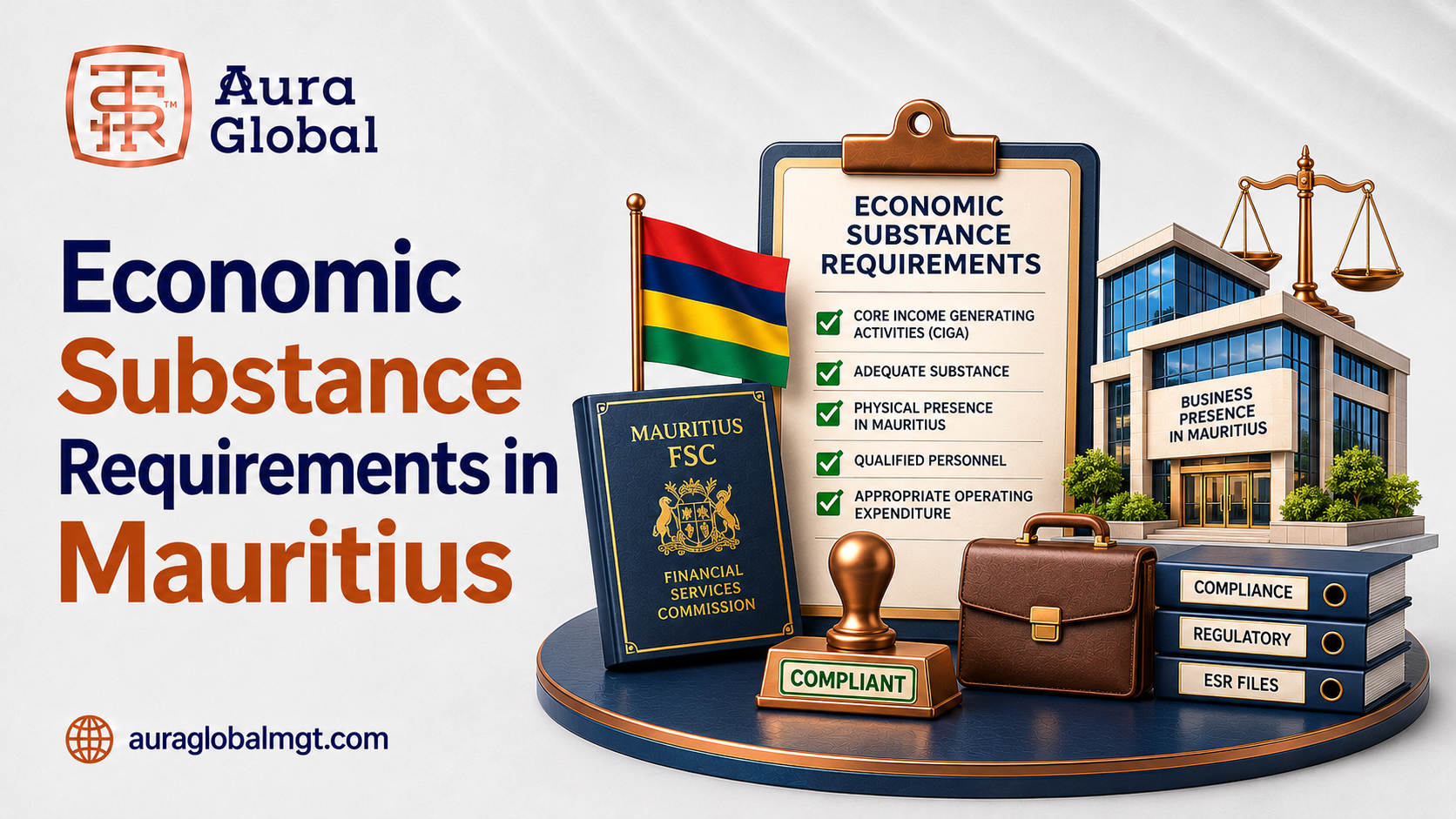
In short, a GBC must show real activity and decision-making in Mauritius. Typical expectations include:
- At least two resident directors of sufficient calibre
- Management and control exercised from Mauritius
- Core income-generating activities carried out in or from Mauritius
- Accounting records kept in Mauritius
- A licensed management company acting as registered agent
- Board meetings held in Mauritius with meaningful discussion
- Adequate local expenditure and, where relevant, suitably qualified people
The precise test depends on your business model and your FSC licence, so always check the latest FSC guidance.
What is economic substance?
Economic substance means that a company’s presence in a jurisdiction is real and not just on paper. A company with substance has people, decisions, records and spending connected to the place where it says it operates.
In Mauritius, the idea comes from the global push against profit shifting, driven by international standards such as the OECD’s work on base erosion. Mauritius reformed its global business regime in 2019, replacing older categories with the Global Business Company and the Authorised Company, and tightening substance expectations for GBCs in the process.
A GBC holds a Global Business Licence from the Financial Services Commission (FSC) and conducts business principally outside Mauritius. An Authorised Company is a lighter structure that does not benefit from tax residence in the same way.
How substance requirements work in practice
The FSC does not just ask you to tick boxes. It looks at your overall picture. It asks whether strategic decisions are genuinely made in Mauritius, who is involved, and whether your operations match your story.
The FSC has also issued notes on the monitoring of substance requirements, and licensed management companies play a central role in checking and reporting. In 2026, the FSC added further oversight by involving management companies in bank signatory arrangements for GBCs, which shows that regulators continue to tighten governance.
Substance also affects tax. To obtain a Tax Residence Certificate and use the Partial Exemption Regime, a GBC needs to satisfy substance conditions. Without substance, treaty benefits and exemptions can come under pressure.
Why meeting substance requirements benefits you
It is tempting to see substance as a cost. But it also brings value:
- Treaty and tax benefits. Substance supports your tax residence and partial exemption position.
- Banking access. Banks are more comfortable with companies that show real local presence.
- Counterparty confidence. Investors, lenders and partners feel safer dealing with a well-governed structure.
- Lower regulatory risk. Strong records reduce the risk of difficult questions during FSC reviews.
The risks of getting substance wrong
Not every structure faces the same exposure, but common risks include:
- Challenge to your tax residence or exemption claims
- FSC scrutiny, penalties or licence consequences
- Difficulty opening or keeping bank accounts
- Reputational damage with partners and investors
- Higher costs when you have to fix problems retroactively
A simple example: if all your key decisions are clearly taken abroad and the Mauritius directors merely sign papers, a reviewer may conclude that management and control do not really sit in Mauritius.
The core Mauritius economic substance requirements
Resident directors
A GBC must have at least two directors resident in Mauritius who have sufficient calibre to exercise independence of mind and judgement. They should be real decision makers. Directors who just rubber-stamp resolutions create risk.
Management and control
Strategic decisions should be taken in Mauritius. That means board meetings held on the island, with agendas, discussions and minutes that reflect genuine decision-making.
Core income-generating activities (CIGA)
The company must carry out its core income-generating activities in or from Mauritius. For a holding company, that may mean managing investments and shareholder rights. For a financing business, it may mean assessing credit risk and managing loans. What counts depends on your activity.
Management company and registered agent
Every GBC must appoint a licensed management company in Mauritius. This provider helps with substance, filings and AML compliance.
Accounting records and bank account
Accounting records should be kept in Mauritius, and the company is generally expected to maintain bank accounts there as part of its operating footprint. Many GBCs also need audited financial statements.
Local expenditure and people
Depending on your activity, the FSC expects reasonable local expenditure and, where appropriate, qualified personnel in Mauritius. A pure holding structure may need less than an operating business. A fund manager or trading business will usually need more.
Step-by-step: how to build and prove substance
- Map your activities. List what your company does and which functions generate income.
- Identify the Mauritius connection. For each function, decide who does it and where.
- Appoint the right directors. Choose resident directors who understand your business and can challenge decisions.
- Set a board calendar. Plan regular meetings in Mauritius with proper agendas.
- Fix your records. Keep accounting records, minutes and contracts in Mauritius.
- Strengthen your bank setup. Make sure account operations match your governance model.
- Gather evidence. Collect proof such as minutes, invoices, payroll records, office agreements and travel evidence.
- Review annually. Revisit your setup whenever your business changes.
Expert tips for staying compliant
- Build substance around your real business. Copy-paste structures are easy to challenge.
- Choose directors carefully. Look for experience, availability and independence, not just a signature.
- Document the story. Minutes should show genuine debate and rationale.
- Watch the rules. Fees, bank signatory rules and filing expectations have been updated recently, so review them regularly.
- Link substance to tax. If you claim the partial exemption regime, test your substance first.
- Do a yearly health check. A short review beats a rushed fix.
Common mistakes
- Holding board meetings abroad without a clear reason
- Using the same two directors across dozens of unrelated companies
- Keeping records outside Mauritius
- Assuming substance is only the management company’s job
- Ignoring changes to your business model
Frequently asked questions
What are the economic substance requirements for a GBC in Mauritius?
A GBC must show real activity in Mauritius. This usually includes at least two resident directors of sufficient calibre, management and control exercised locally, core income-generating activities in or from Mauritius, accounting records kept locally and a licensed management company as registered agent.
Who monitors economic substance in Mauritius?
The Financial Services Commission supervises substance for licensed companies and has issued notes on monitoring. Management companies also play an important role, as they help GBCs comply and report. Tax authorities may also look at substance when you apply for treaty benefits.
Do Authorised Companies need economic substance?
Authorised Companies operate under a different regime and do not have the same tax residence status as GBCs. They still must meet licensing and compliance rules. If you plan to rely on treaties or exemptions, you will probably need a GBC with proper substance.
Can I use nominee directors?
Resident directors must be genuinely able to exercise independent judgement and take part in decisions. Directors who simply sign what they are told create risk. Choose experienced professionals who understand your business and can challenge your plans.
How does substance affect my tax residence certificate?
A Tax Residence Certificate is usually linked to your GBC status and to meeting substance conditions. If your substance is weak, you may face questions when applying or renewing, and treaty benefits can be affected. Keep evidence ready for any review.
How much does it cost to maintain substance?
Costs depend on your activity. A simple holding structure may need little more than directors, a management company and records. An operating business needs more people and spending. Aura Global Management can estimate a budget based on your structure.
Conclusion: treat substance as a strength
The Mauritius economic substance requirements are not designed to make life harder for genuine businesses. They exist to separate real structures from empty shells. If your company has real decisions, real people and clear records, substance becomes a strength.
Want a clear view of where you stand? Aura Global Management helps GBCs review their governance, evidence and filings. Book a substance health check and get practical, jurisdiction-specific advice.